backroom
methods and maker’s gossip
Other sections of this website include mostly ceramic products : this section is more about methods and discussion of ceramic practice, especially relating to preparing glazes from plant ash.
There is a great deal of material available on how to prepare ash glazes. Quite often, the assumption is that you have a batch of ash and would like to move on to making some form of ceramic glaze, perhaps beginning from some tests on how to optimise the mix of ash and other materials to get the glaze effect you want. The focus here is not so much on those steps, but more on factors affecting the choice of plant ash, including looking at tests to highlight differences between plant ash types and trying to get a clearer map of how plant ash types differ in ceramic effects.
For some users of ash glazes, any extensive experimentation with ash types may not be very relevant. It may be that there are only a few sources of ash readily accessible. It may be that preferred methods of production and glaze application require a large and relatively uniform stock of glaze: in this case , experimentation with small batches of ash from particular species may be beside the point. It may be that large volumes of wood are needed for woodfiring as well as glaze preparation, in which case identifying contributions to ceramic effects from individual tree species may be difficult and not important for the ceramic objectives.
Many of the pieces illustrated on this site were produced with a process of handbuilding with soft slabs, in which the glaze was incorporated before completion of the slab, in the form of dried segments laid on the plaster slab before pouring of liquid clay. Among the many pros and cons of this method of glaze application, it does have the feature that very small quantities of plant ash become usable, also allowing combination of multiple ash types in a single composition. In particular, this method lends itself to exploring diversity in plant ash types, allowing transcription of plant diversity into a juxtaposition of diverse ceramic effects.
Diversity in plant ash
Plant ash, especially if ground and sieved to a standard particle size, is not very diverse to look at – a white, grey or black powder. How dark the ash is most likely reflects carbon content, indicating how far the plant material oxidised in the process of burning, not likely to be relevant to ceramic properties after firing burns off all residual carbon.
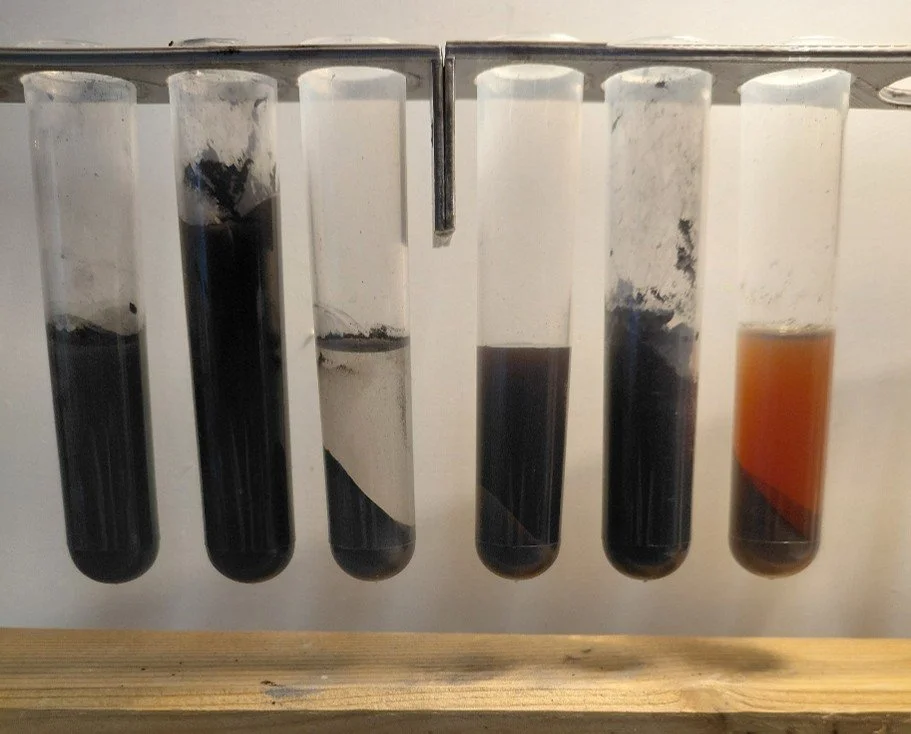
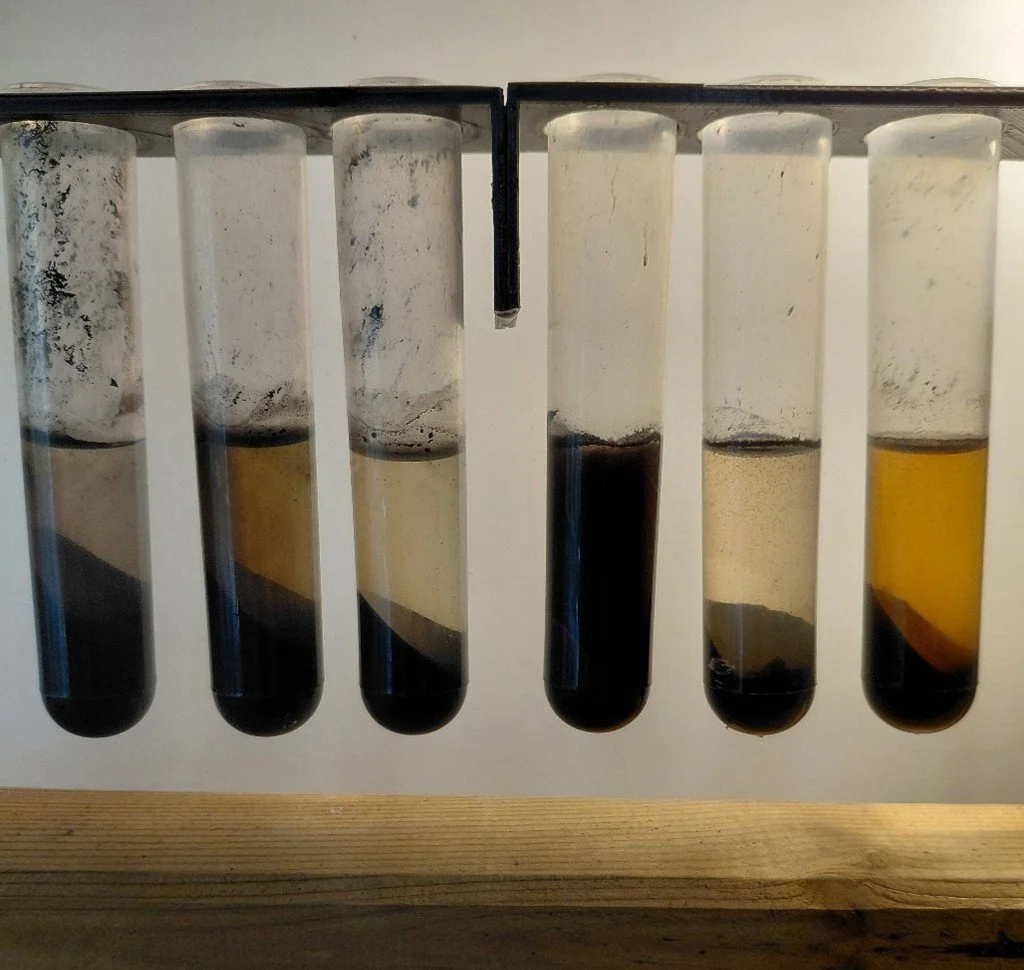
Adding water can highlight two new characteristics. As shown in the samples here (Monterey pine cone, London plane leaf, nettle, carex sylvatica, goosegrass and bramble), a first difference is the colour of the liquid when ash is partly dissolved, varying from totally clear to pale or murky browns, brilliant reds or solid black. Secondly, the liquid has a pH value, usually well above a neutral value for water, indicating a degree of alkalinity. It would be quite helpful if these rather easily identified characteristics give us some preliminary guide to how the ash might perform as a glaze material, or at least some indication of similarity or difference from other ashes with known ceramic effects.
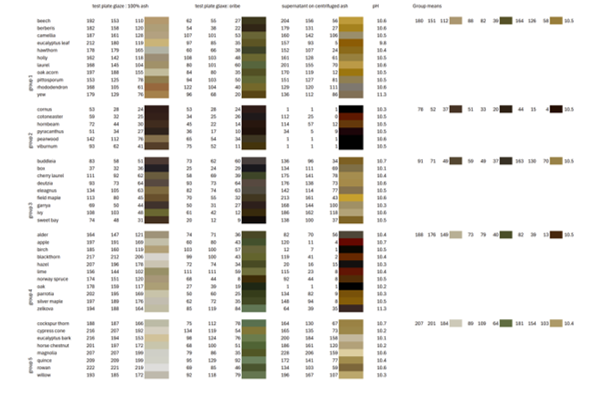
The table here shows results from ash samples from 47 species. The third main colour strip represents the colour of the supernatant liquid after centrifuging a standard sample, based on RGB values from a photograph. This can be compared with results from a set of ceramic glaze tests carried out in 2020, with the first set showing results for a 100% ash glaze and the second set showing a uniform oribe glaze, differing only by ash content. The results are in groups, based on cluster analysis giving equal weight to the colour values and PH reading.
While far from ideal as a representation of glaze effects, the grouping of results in this format does suggest some interesting generalisations. Groups 2 and 3 show dark colours on 100% ash and oribe but differ in supernatant colour. Group 4 and 5 mostly have very pale or transparent results for 100% ash and mid green oribe, but the supernatant is clear to pale brown for group 5 but strong reds or mid brown for group4. The pH values fall within a range 9.5 to 11.3, with little difference in mean values between groups.
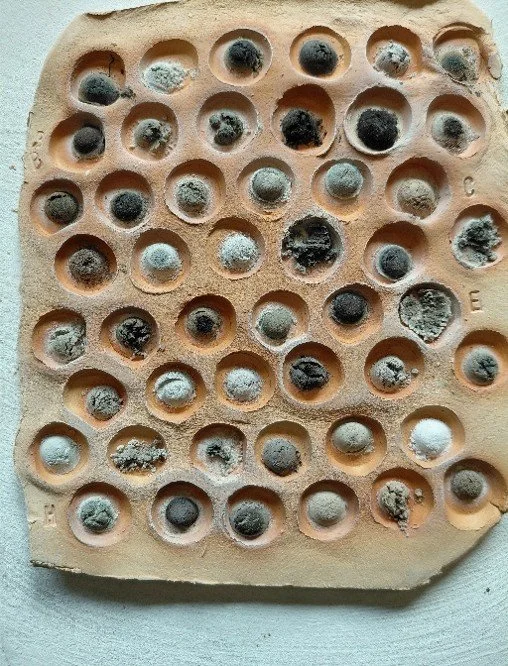
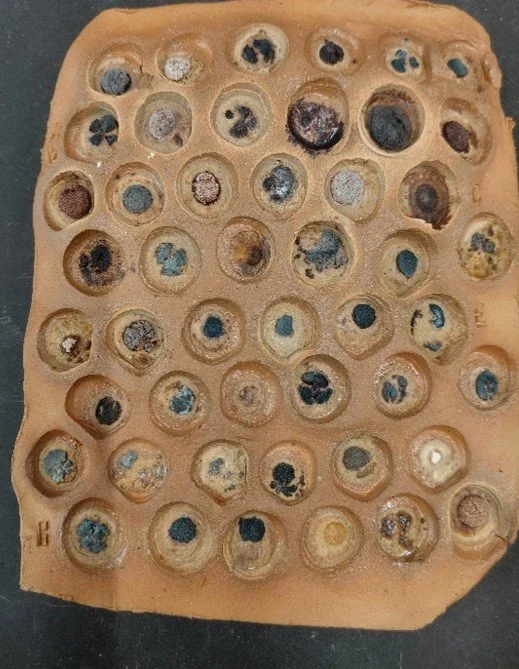
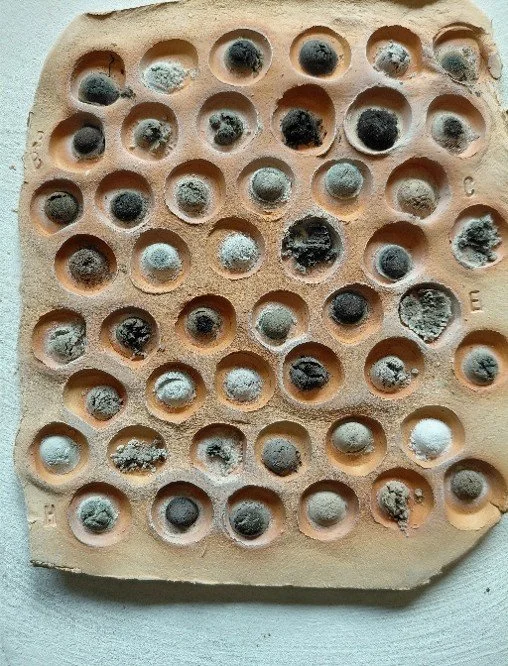
Melt tests can also be a useful preliminary trial. The images here show tests at 1000 and 1200 – many show signs of partial sintering at the lower temperature and some are fully vitrified at 1200. This is both useful as a signal for possible low temperature glazes but also adds to the wider picture of ash variation.
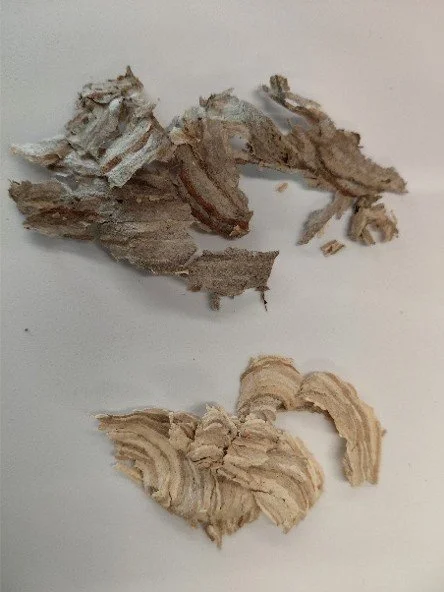
As an illustration of using an initial colour test, the image here shows results from 6 ash samples. The first two are from the ash of wasp nests.
The wasp nests were formed, one close to a lime tree, the other not far away but nearer to oak trees, with poplar and apple among other woody sources nearby. Without claiming any rigorous analysis of where the wasps obtained their fibre, it was interesting to see how the two nest ashes compared, both to each other and to ash for lime, oak, poplar and apple. On the face of it, lime (clear) and apple (red-brown) look less likely as candidate material but poplar or maybe oak seem more promising. Preliminary glaze testing may show a different picture, but the initial test gives a useful steer and perhaps it will one day merit a wasp nest pot to tell the story.
Diversity in plant ash and diversity in plants
With a very preliminary map of different glaze effects with different plant ashes, it is interesting to see how this map can be interpreted and improved by comparing the grouping above with what is known of plant chemistry among these species. Plant biochemistry has been an immensely active field of research in recent decades with many studies of plant composition and prevalence of the oxides and trace elements that are likely to be the source of ceramic glaze effects. It is increasingly feasible to build up an inventory of chemical analysis for most plant species, which can shed light on similarities between ash effects and also suggest explanations for both colour variation and many other glaze effects like crazing, crawl, degree of vitrification, etc.
Many discussions of ash glaze distinguish between wood ash, as a source of flux materials, predominantly calcium, or other ashes such as grass with high levels of silica. Recently, a database of silicon contents in more than 1800 plant species was compiled. While this shows that the woody plants do generally have lower proportions of silicon in their mineral composition, it’s also true that high levels of silicon content can be found in some trees, while non wood plants vary greatly in silicon content.
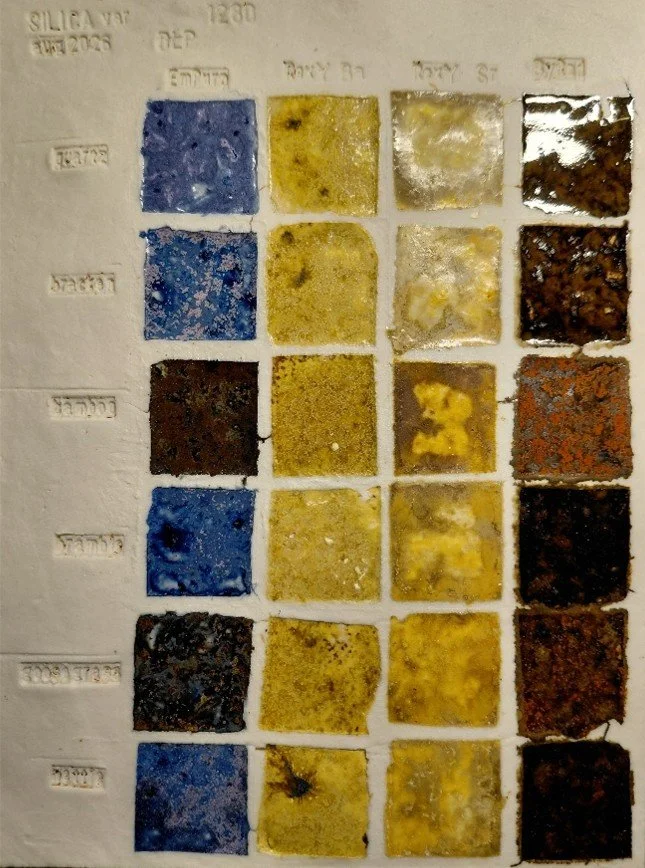
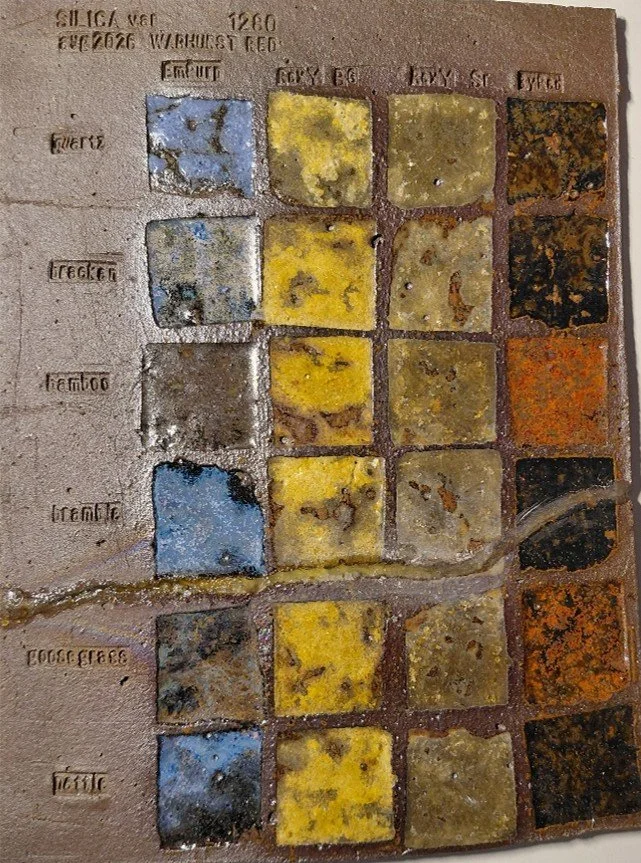
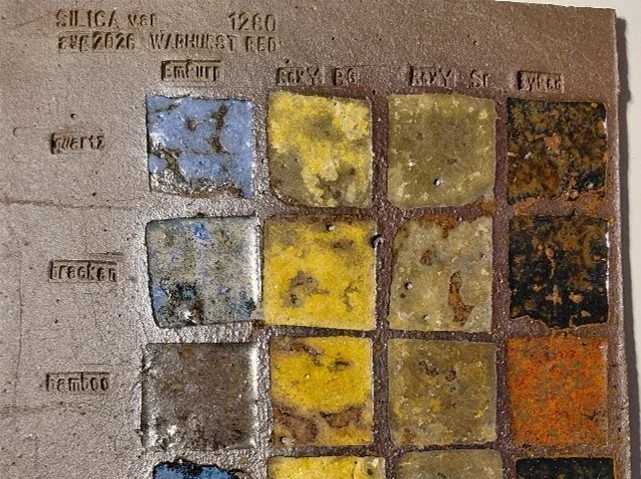
Below are two test plates for silica variants, testing quartz (row one) compared to substitutions with bracken, bamboo, bramble, goosegrass and nettle for four different glaze variants. The same materials were tested on porcelain (left) and Wadhurst clay (right) both fired at 1280 (please try to ignore the large crack on the Wadhurst plate!). Some of the ash alternatives are not strikingly different from results for quartz, though bamboo and goosegrass show some notable divergence. The bamboo result agrees with other tests that imply relatively low level of silica, something that shows up in some chemical analysis, even though some bamboos (eg Arundinaria gigantea) have among the highest recorded levels of silica in the plant silicon database. A test on half a dozen bamboo variants is already under way….
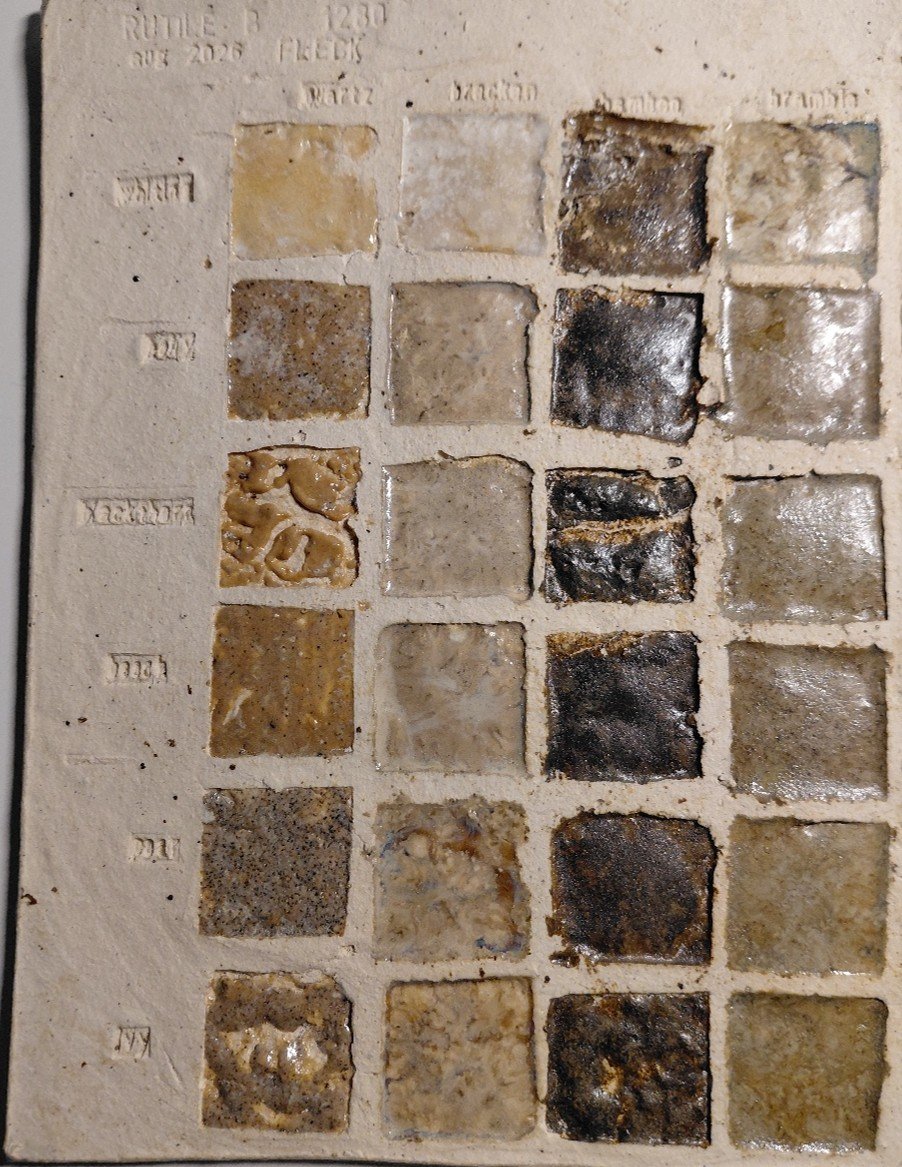
Looking for diverse ceramic effects from plant ash, it helps to keep both flux and silica levels in mind. The test plate below looks at varying a standard recipe using whiting and quartz, substituting for the whiting a selection of wood ashes while replacing quartz with other ashes likely to contribute silica. As for the silica test above, the ‘normal’ case is shown first with whiting in the first row and quartz in the first column, followed by columns of bracken, bamboo and bramble as substitutes for silica. Substitutes for calcium follow the rows below whiting with holly, blackthorn, beech, pear and ivy (roughly as representative ashes for the ash groups identified above).
Divergent results show up again for bamboo. Some of the tests show crawl, possibly a high level of magnesium in the blackthorn ash and maybe ivy, something which appears in other tests. As a first scan of ash alternatives with the particular recipe, it will evidently need further optimising work on individual cells to arrive at satisfactory glazes but it does provide a first map of possible variations. By working with two dimensions of substitution the range of variation is extended. Quite often the value of a cross scan like this can be seeing glazes that might work together as natural variation, echoing diversity in the plant originals.