history
The varied objectives and expectations which users bring to the topic of ash glazes often bear close relation to the tangled threads of the recent history of ash glaze practice. While the use of ash in ceramic glazes has a history of several thousand years including early Chinese pottery and use of soda ash in ancient middle eastern ceramics and glass making, in the UK, a key surge in interest in ash glazes was associated with Bernard Leach and followers in adoption of Japanese traditional ceramic practices in the twentieth century.
Some index of attention to the topic can be seen in the record of ash glaze related items in the publications of Ceramic Review since 1970.
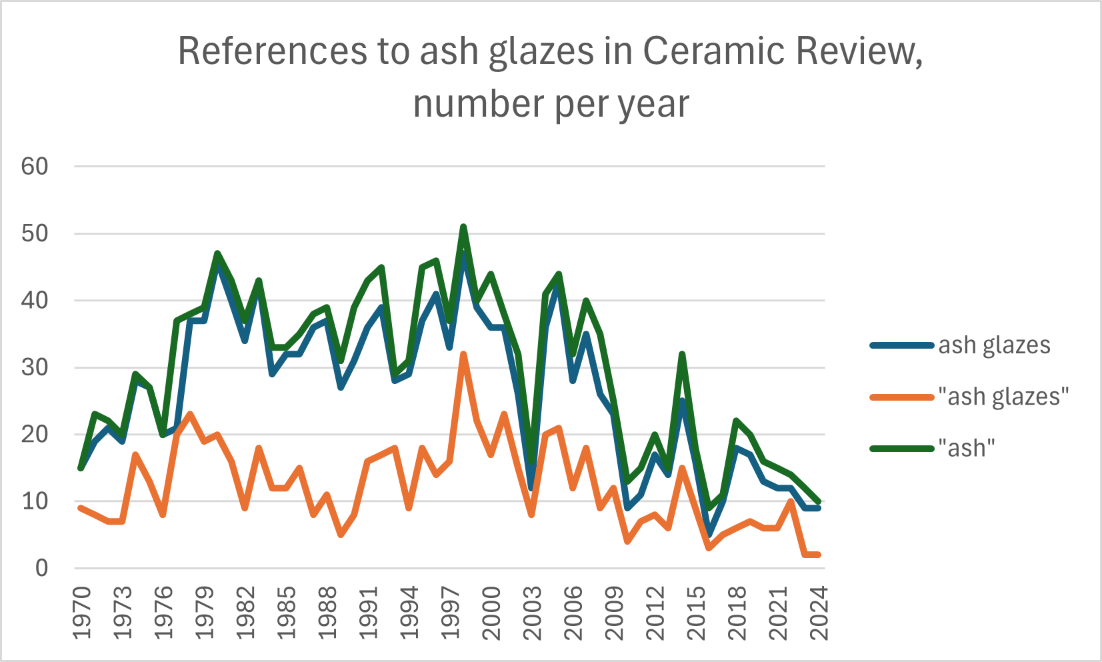
While the topic has been of interest throughout the period, there was clearly a rapid growth in the 1970s, sustained to the early 2000s and gradually diminishing over the last two decades. Perhaps this arc of rising and falling attention echoes something similar in the US : Koplos and Metcalf in their history of American studio craft (‘Makers’, 2010) note rising interest from the 1970s , captured in books by Danial Rhodes and Jack Troy, noting limited critical attention. (“Although the Japanese have discussed such issues for 500 years, Americans have barely gotten below the surface”).
Looking at Ceramic Review material in the earlier period, the majority of articles relate to ash in general or mixed wood ash, with two major exceptions. Katherine Pleydell-Bouverie carried out extensive testing of different plant species and reported the results both in published articles and in decades of meticulously recorded notebooks, held in the archive of her work at Farnham. Her research, summarised briefly in Leach’s ‘A Potter’s Book’, appears to have been widely used as broad guidance on ash glazes, although not so many seem to have pursued the distinction between species ashes which she pursued so vigorously.
A second prominent figure in earlier Ceramic Review articles is Eric Mellon, who wrote several articles in the period and also collaborated with others in chemical testing of ashes. He showed considerable interest in distinguishing different ashes by their ceramic effects, including developing a theory that variation in plant ash effects was related to plant height. Probably his motivation for differentiating plant ashes related to his use of glazes in figurative surface decoration, requiring close control of colour and other effects, asdeveloped further in his book ‘Decorating Stoneware’ (Mellon and Foster, 2007).
Michael Cardew’s ‘Pioneer Pottery’ (1969) demonstrated a practice that maximises use of natural materials, including ash glazes. The text includes chemical analysis of a dozen or more species but beyond a broad distinction between wood ash and grass based ashes rich in silica, distinction between species is not emphasised in practical use.
For potters broadly within the Leach Cardew tradition, there are some particular obstacles to putting much emphasis on species differences in ash. If glaze is applied by dipping thrown pots, in addition to any glaze deposited from volatile elements in wood firing, the species mix of ash will depend on the hazards of wood supply. Making up a bucket of glaze requires a significant amount of ash, which itself may be only 1% of original wood volume. In these quantities, it may not be easy to establish supply of a uniform material or experiment with multiple separate species.
The need for volumes of ash of consistent character also features prominently in Phil Rogers’ 1992 book ‘Ash Glazes’ (3rd edition, 2023), which provides an excellent summary of history and practice of ash glaze use and is probably regarded by many as the principal text on ash glaze practice. While fully acknowledging Pleydell Bouverie’s contribution to ash glaze development, his book does not in general adopt her close interest in species differences. He concludes that the variability of ash renders chemical analysis of limited value, and favours use of ash from stable supplies that may offer some consistency, whether of known species or mixed.
A key source for Rogers’ book was the earlier work by an American chemist-potter, Robert Tichane, ‘Ash Glazes ‘ published in 1987 , one of a series of Oriental glaze monographs. Tichane’s work has been credited with reviving interest in ash glazes, through a careful analysis of links between chemistry and glaze effects. One of the aspects Tichane explored was the possibility of reproducing ash glaze effects with identified chemicals from non ash sources, leading to interest in fake ash glazes and similar recipes, discussed by John Britt in his ‘High Fired Glazes’. Rogers is clearly uncomfortable with these aspects of Tichane’s work, arguing at one point that Tichane has ‘completely missed the point of ash glazes’. Reading his account of his own ambivalent -even agonised - reaction to a work by his student which used substitute materials yet appeared indistinguishable from ‘true ash’ suggests a moment of conceptual crisis rather akin to Arthur Danto pondering the implications of a Warhol Brillo box, or his thought experiment of a gallery of red squares. There is something about the use of ash – an ill-defiend conceptual surplus - which isn’t fully captured in the strictly visual or tactile characteristics.
Contrasting the different approaches of Pleydell Bouverie, Mellon, Tichane and Rogers (among many others), one thing that is clear is that the ‘point’ of ash glazes is an elusive concept, varying quite widely across the spectrum of ash glaze practitioners. These figures in the recent history of ash glazes - selected from many others - can help to illustrate some of some of the characteristic faultlines that show up in contemporary approaches to ash glazes.
The role of tradition. The preface to Phil Rogers’ ‘Ash Glazes’ highlights the role of tradition, even to the extent of citing Eliot’s essay ‘Tradition and the Individual Talent’. Leach’s use of ash glazes clearly followed oriental traditions, including collaboration with Japanese artists such as Shoji Hamada and Matsuyabashi (a key source for Katherine Pleydell Bouverie and others in Leach’s circle). The Potter’s Book in its regard for pottery traditions and oriental practice established a new synthetic tradition of considerable cultural weight.
Use of natural materials. In principle, use of natural materials is a key thread in the Leach Cardew tradition, and for Pleydell-Bouverie it became quite central with extensive research of individual ashes over several decades. She wanted her pots to evoke, not oriental models but a sense of the natural world. As research on a unique, versatile and highly complex ceramic material, her work is a resource for all ceramic practice – wood firing or electric kiln, thrown or handbuilt, followers of any tradition or none. But relatively few followed her lead in focussing on differentiating individual species. Rogers’ later summary of the practice largely took a different perspective, arguing the vagaries of analysis and the difficulty of getting sufficient uniform predictable material. It is an interesting paradox that the tradition most associated with ash glazes may, through other aspects of their practice, such as woodfiring and glaze application methods, have inadvertently interrupted a wider development of ash glaze practice.
Use of analysis, role of science. Attitudes to use of scientific knowledge in ceramic practice are similarly varied, and though this might be expected to vary inversely with respect for tradition, plenty of examples show it is not that simple. Rogers begins his book with a quotation from Pleydell-Bouverie – “Curiosity and a resilient attitude towards unpleasant shocks, are of more use in the making of glazes than a wagonload of analysis” – which many practitioners could echo. Yet Pleydell-Bouverie’s sources were not necessarily confined to the copious notes she took from Matsu’s tuition. Research under way by Helen Ritchie at the Fitzwilliam Museum will surely shed more light on this.